| |
Soluble Receptor for Advanced Glycosylation End Products (sRAGE) ELISA, Antibody & Recombinant
| sRGAE is a novel biomarker for cardiovascular diseases |
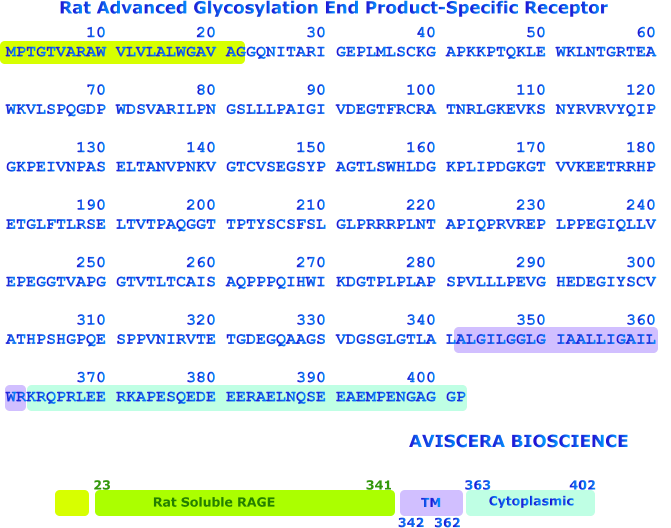
| Rat Soluble RAGE recombinant (catalog No.: 00112-03-100)had been used by Dr. Guo on her research paper: Caixia Guo, et al. A Soluble Receptor for Advanced Glycation End-Products Inhibits Hypoxia/Reoxygenation-Induced Apoptosis in Rat Cardiomyocytes via the Mitochondrial Pathway.Int J Mol Sci. 2012;13(9):11923-40.
|
Effects of atorvastatin on
progression of diabetic nephropathy and local RAGE and soluble
RAGE expressions in rats |
Objective: Advanced glycation end-products
(AGEs) exert inflammatory and oxidative stress insults to
produce diabetic nephropathy mainly through the receptor for
AGEs (RAGE). This study aimed to assess the effect of
atorvastatin on diabetic nephropathy via soluble RAGE (sRAGE)
and RAGE expressions in the rat kidney. Methods: Thirty-two
male Sprague-Dawley rats were divided into four groups based
on the presence or absence of streptozotocin-induced diabetes
with or without atorvastatin treatment (10 mg/kg for 24
weeks). Serum sRAGE and glycated albumin (GA) levels were
measured with enzyme-linked immunosorbent assay (ELISA) and
improved bromocresol purple methods. Renal AGEs, RAGE,
endogenous secretory RAGE (esRAGE), and sRAGE were determined
with reverse transcription-polymerase chain reaction (RT-PCR)
and Western blotting. Results: Mesangial expansion and
microalbuminuria were aggravated in diabetic rats, and
improved with atorvastatin treatment. Serum sRAGE levels were
lower in diabetic than in normal rats. After atorvastatin
treatment, serum and renal sRAGE levels were up-regulated,
while renal RAGE expression was decreased in diabetic rats,
associated with a reduction in accumulation of AGEs, though
renal esRAGE mRNA expression was not significantly increased.
Conclusions: Atorvastatin exerted a beneficial effect on
diabetic nephropathy with reduced AGE accumulation,
down-regulating RAGE expression and up-regulating sRAGE in the
kidney.
|
|
Lu L., et al. J
Zhejiang Univ Sci B.
2011 August; 12(8):
652–659.
|
| |
Advanced Glycation End Products
Accelerate Ischemia/Reperfusion Injury Through Receptor of
Advanced End Product/Nitrative Thioredoxin Inactivation in
Cardiac Microvascular Endothelial Cells
|
| The advanced glycation end products (AGEs)
are associated with increased cardiac endothelial injury.
However, no causative link has been established between
increased AGEs and enhanced endothelial injury after
ischemia/reperfusion. More importantly, the molecular
mechanisms by which AGEs may increase endothelial injury
remain unknown. Adult rat cardiac microvascular endothelial
cells (CMECs) were isolated and incubated with AGE-modified
bovine serum albumin (BSA) or BSA. After AGE-BSA or BSA
preculture, CMECs were subjected to simulated ischemia
(SI)/reperfusion (R). AGE-BSA increased SI/R injury as
evidenced by enhanced lactate dehydrogenase release and
caspase-3 activity. Moreover, AGE-BSA significantly increased
SI/R-induced oxidative/nitrative stress in CMECs (as measured
by increased inducible nitric oxide synthase expression, total
nitric oxide production, superoxide generation, and
peroxynitrite formation) and increased SI/R-induced nitrative
inactivation of thioredoxin-1 (Trx-1), an essential
cytoprotective molecule. Supplementation of EUK134
(peroxynitrite decomposition catalyst), human Trx-1, or
soluble receptor of advanced end product (sRAGE) (a RAGE
decoy) in AGE-BSA precultured cells attenuated SI/R-induced
oxidative/nitrative stress, reduced SI/R-induced Trx-1
nitration, preserved Trx-1 activity, and reduced SI/R injury.
Our results demonstrated that AGEs may increase SI/R-induced
endothelial injury by increasing oxidative/nitrative injury
and subsequent nitrative inactivation of Trx-1. Interventions
blocking RAGE signaling or restoring Trx activity may be novel
therapies to mitigate endothelial ischemia/reperfusion injury
in the diabetic population. Antioxid. Redox Signal. 15,
1769–1778. |
| Liu Y. et al. Antioxid. Redox Signal.
2011, 15, 1769–1778. |
| Activation of the Receptor for Advanced Glycation End Products System in Women with Severe Preeclampsia |
| Context: Activation of the receptor for advanced glycation end products (RAGE) mediates cellular injury. Soluble forms of RAGE [soluble RAGE (sRAGE), endogenous secretory (esRAGE)] bind RAGE ligands, thereby preventing downstream signaling and damage. Objectives: The objective of the study was to characterize the changes in maternal serum, amniotic fluid, and cord blood soluble receptor for advanced glycation end products (sRAGE) during physiological gestation and to provide insight into mechanisms responsible for RAGE activation in preeclampsia. Design and Settings: This was a cross-sectional study at a tertiary university hospital. Patients: We studied 135 women in the following groups: nonpregnant controls (n = 16), healthy pregnant controls (n = 68), pregnant women with chronic hypertension (n = 13), or pregnant women with severe preeclampsia (sPE; n = 38). Interventions and Main Outcome Measures: sRAGE and esRAGE levels were evaluated in vivo by ELISA in maternal serum, amniotic fluid, and cord blood and in vitro after stimulation of the amniochorion and placental explants with lipopolysaccharide or xanthine/xanthine oxidase. Placenta and amniochorion were immunostained for RAGE. Real-time quantitative PCR measured RAGE mRNA. Results: Pregnant women had significantly decreased serum sRAGE compared with nonpregnant subjects (P < 0.001). sPE women had higher serum and amniotic fluid sRAGE and esRAGE relative to those expected for gestational age (P < 0.001). Cord blood sRAGE remained unaffected by sPE. RAGE immunoreactivity and mRNA expression appeared elevated in the amniochorion of sPE women. Xanthine/xanthine oxidase (but not lipopolysaccharide) significantly up-regulated the release of sRAGE (P < 0.001) in the amniochorion explant system. Conclusions: Fetal membranes are a rich source of sRAGE. Elevated maternal serum and amniotic fluid sRAGE and esRAGE, paralleled by increased RAGE expression in the amniochorion, suggest activation of this system in sPE. |
|
Oliver EA et al. J Clin Endocrinol Metab. 2011 Feb 16. [Epub ahead of print]
|
| Effects of atorvastatin on serum soluble receptors for advanced glycation end-products in type 2 diabetes |
| Tam HL et al. Atherosclerosis. 2010 Mar;209(1):173-7. Epub 2009 Aug 21. |
| Enhanced expression of receptor for advanced glycation end-products is associated with low circulating soluble isoforms of the receptor in Type 2 diabetes |
| Tam XH et al.Clin Sci (Lond). 2011 Jan;120(2):81-9. |
 |
| |
 |
| |
 |
|
| |
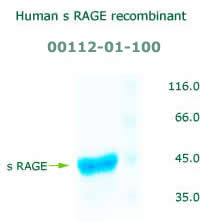
Code No.:00112-01-100
Size: 100ug
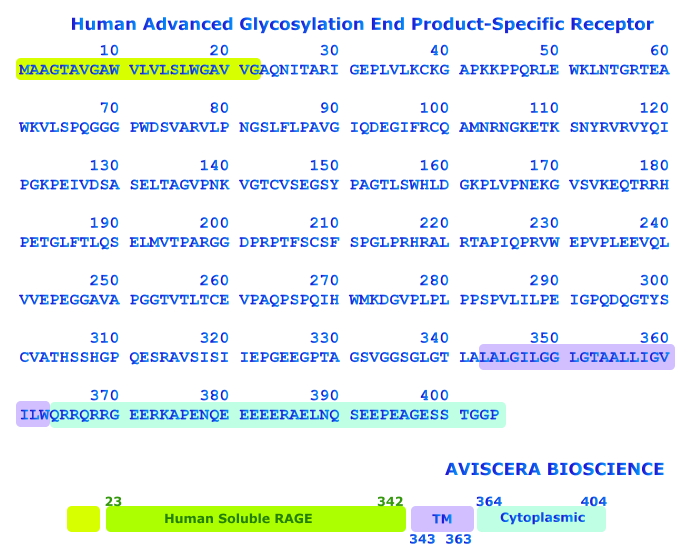
Portein ID: Q15109
Gene ID: 177
MW : 39 KD
Tag : 6x His Tag on N-Terminus
Expressed : E. Coli
More info: Data Sheet |
| |
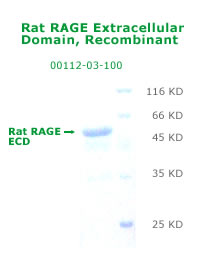
Code No.:00112-03-100
Size: 100ug
Portein ID: Q63495
Gene ID: Rn.9829
MW : 33.9 KD
Tag : 6x His Tag on N-Terminus
Expressed : E. Coli
More info: Data Sheet |
| |
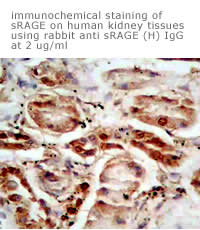
Code No.: A00112-02-100
Size: 100 ug
Ab Type: Polyclonal IgG
Purification: Protein A
Host: Rabbit
Antigen: sRAGE (Human) rec.
Positive tissues: paraffin-embedded human kidney tissues
Working Conc.: 2 ug/ml (Overnight incubation)
Protocol: ABC
More Info: PDF
|
|
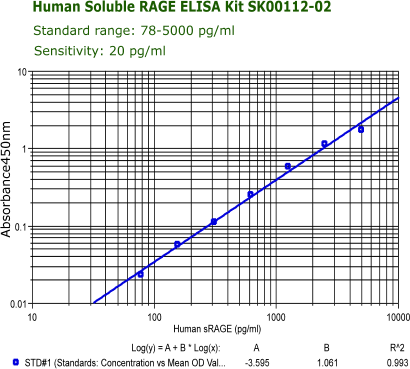
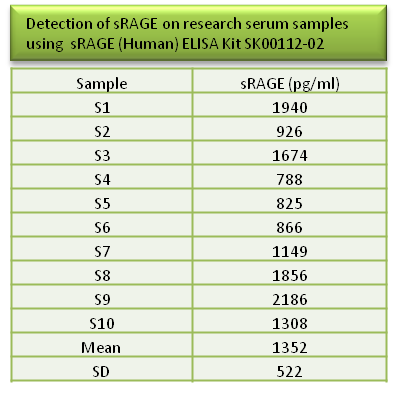
Code No.: SK00112-02
Size: 96T
Sensitivity: 20 pg/ml
Standard rage: 78-5000 pg/ml
Sample type: Serum, Plasma
Sample Volume: 100 uL
Intra CV: 6-8%
Inter CV: 10-12%
More Info: Protocol
|
| |
Code No.:SK00112-03
Size: 96T
Standard Range: 0.026-400 ng/ml
Linear range: 130-80000 pg/ml
Sensitivity: 50 pg/ml
Specificity: Mouse, Rat
Sample type: serum or plasma
Intra CV: 6-8%
Inter CV: 10-12%
More Info: Protocol
|
| |
Code No.: A00112-03-100
Size: 100 ug
Ab Type: Polyclonal IgG
Purification: Protein A
Host: Rabbit
Antigen: sRAGE (Rat), rec
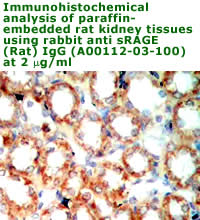
Positive tissues: paraffin-embedded rat and mouse kidney tissues
Working Conc.: 2 ug/ml (Overnight incubation)
Protocol: ABC
More Info: PDF
|
| |
Code No.: A00112-09-100
Size: 100 ug
Ab Type: Polyclonal IgG
Purification: Protein A
Host: Rabbit
Antigen: human esRAGE C-Terminal Rec
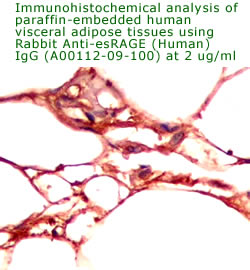
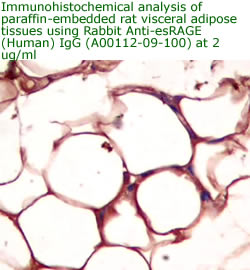
Positive tissues: paraffin-embedded human and rat visceral adipose tissues
Working Conc.: 2 ug/ml (Overnight incubation)
Protocol: ABC
More Info: PDF
|
| |
Code No.: A00112-09-100
Size: 100 ug
Ab Type: Polyclonal IgG
Purification: Protein A
Host: Rabbit
Antigen: human esRAGE C-Terminal Rec
Positive tissues: paraffin-embedded human and rat visceral adipose tissues
Working Conc.: 2 ug/ml (Overnight incubation)
Protocol: ABC
More Info: PDF
|
Rabbit Anti esRAGE (Human) IgG (A00122-09-100) is available in stock that enables to detect esRAGE in serum. This antiobdy does not indicated crossreactivity with recombinat human sRAGE on ELISA.
| Name |
|
Code No. |
Size |
Price ($) |
| Soluble RAGE (Human) ELISA Kit |
serum, plasma |
|
96T |
360.00 |
| Soluble RAGE (Human) ELISA Kit |
serum,plasma |
|
96T |
360.00 |
| es RAGE (Human) ELISA Kit |
serum,plasma |
SK00112-08 |
96T |
800.00 |
| Soluble RAGE (Rat/Mouse) ELISA Kit |
serum,plasma |
|
96T |
360.00 |
| Mouse sRAGE ELISA Kit |
serum, plasma |
SK00112-04 |
96 T |
390.00 |
| Rat sRAGE ELISA Kit |
serum, plasma |
SK00112-07 |
96 T |
390.00 |
| sRAGE (Human) Rec. |
E. Coli |
00112-01-50 |
50 ug |
220.00 |
| sRAGE (Human) Rec. |
E. Coli |
|
100 ug |
360.00 |
| sRAGE (Human) Rec. |
E. Coli |
00112-01-1000 |
100 ug |
inquire |
| sRAGE (Human) Rec. |
E. Coli |
00112-02-50 |
50 ug |
220.00 |
| sRAGE (Human) Rec. |
E. Coli |
|
100 ug |
360.00 |
| sRAGE (Human) Rec. |
E. Coli |
00112-02-1000 |
100 ug |
inquire |
| sRAGE (Human) Rec. Biotinylated |
E. Coli |
00112-02-50B |
50 ug |
360.00 |
| sRAGE (Human) Rec. Cy3 conjugated |
E. Coli |
00112-02-50C3 |
50 ug |
460.00 |
| sRAGE (Human) Rec. FITC conjugated |
E. Coli |
00112-02-50F |
50 ug |
420.00 |
| Human sRAGE, His Tag, Rec. |
Human cells |
00112-21-50 |
50 ug |
320.00 |
| sRAGE (Rat) Rec. |
E. Coli |
00112-03-50 |
50 ug |
220.00 |
| sRAGE (Rat) Rec. |
E. Coli |
|
100 ug |
360.00 |
| sRAGE (Rat Rec. |
E. Coli |
00112-03-1000 |
1 mg |
inquire |
| sRAGE (Rat) Rec. Biotinylated |
E. Coli |
|
50 ug |
360.00 |
| sRAGE (Rat) Rec. Cy3 conjugated |
E. Coli |
00112-03-50C3 |
50 ug |
460.00 |
| sRAGE (Rat) Rec. FITC conjugated |
E. Coli |
00112-03-50F |
50 ug |
420.00 |
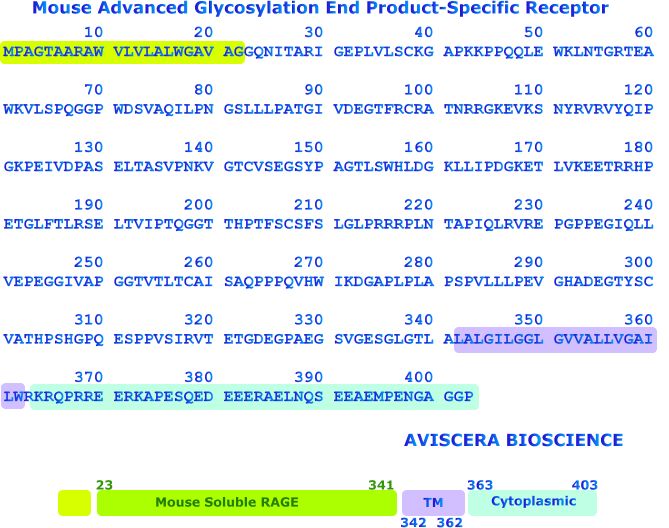
| Mouse sRAGE, Rec. |
Human cells |
00112-06-50 |
50 ug |
390.00 |
| Anti sRAGE (Human) IgG |
Rabbit, IHC, E, WB |
|
100 ug |
220.00 |
| Anti sRAGE (Human) IgG , Biotinylated |
Rabbit, IHC, E, WB |
|
50 ug |
320.00 |
| Anti sRAGE (Human) IgG , Cy3 conjugated |
Rabbit, IHC, E, |
A00112-02-50C3 |
50 ug |
460.00 |
| Anti sRAGE (Human) Monoclonal Antibody |
Clone2F5D11, ELISA |
|
100 ug |
360.00 |
| Anti sRAGE (Human) Monoclonal Antibody |
Clone2F6G5D11H9, ELISA |
|
100 ug |
260.00 |
| Anti esRAGE (Human) Monoclonal Antibody (capture antibody) |
Clone2F5D11D9H4, ELISA |
|
100 ug |
360.00 |
| Anti esRAGE (Human) IgG (Detection Antiobdy) |
Rabbit, IHC,ELISA |
|
100 ug |
360.00 |
| Anti sRAGE (Rat) IgG |
Rabbit, IHC, WB, ELISA |
|
100 ug |
260.00 |
| Anti sRAGE (Rat) IgG , Biotinlyated |
Rabbit, IHC, WB, ELISA |
A00112-03-50B |
50 ug |
360.00 |
Price/availability/specifications subject to change without notice. All products and services are for in vitro research use only. Not for use in or on humans or animals. |
|